Lake Forest

City Market · Available · Orange County, CA

Lake Forest is not one uniform housing market. It layers 1960s and 1970s lake-oriented neighborhoods, dense established central tracts, 1990s foothill master plans in Foothill Ranch and Portola Hills, and a contemporary generation that includes Baker Ranch, Portola Center, Serrano Summit and The Meadows. The market makes sense at the level of the tract, housing era, association structure, tax profile and micro-location.

Research Depth

City structure and market systems
Established
Subdivision map inventory
Established
Association and lake-system structure
Established
Community and tract hierarchy
Research In Progress
HOA dues, CFD and tax verification
Research In Progress
Builder and floor-plan research
Research Planned
MLS micro-market analysis
Established

Durable research last reviewed September 1, 2026

Market Brief

Lake Forest in Brief

Market Identity

A city built in distinct waves: original 1960s and 1970s lake-oriented housing at the center, foothill communities at Foothill Ranch and Portola Hills, and a large band of modern development including Baker Ranch, Serrano Summit, The Meadows and Portola Center.

Housing Snapshot

Housing generations differ by decades inside one city. Original central tracts, two separate private lake-recreation systems, foothill product with open-space adjacency, and new-construction neighborhoods with contemporary plans, newer association structures and different tax profiles.

Common Alternatives

  • Mission Viejo
  • Rancho Santa Margarita
  • Aliso Viejo
Show 1 more
  • Irvine

Key Value Drivers

  • Which lake system, if any, a property belongs to, and whether it has waterfront or dock rights rather than proximity
  • Construction generation, which drives plan, systems age and maintenance expectations
  • Foothill versus central position, including open-space adjacency and access
Show 1 more
  • Association structure and tax profile, which differ sharply between original and modern neighborhoods

Important Watchouts

  • Lake access is a membership and rights question; living nearby does not confer it
  • Baker Ranch is distinguished by having no Mello-Roos, which does not generalize to other modern neighborhoods
  • Special taxes and assessments in newer communities must be read off the actual parcel bill
Show 1 more
  • Fire hazard designation is address-specific, particularly along foothill and open-space edges

Structured intelligence last reviewed September 2, 2026. Summarized from the published Lake Forest research on this page. No pricing, premium or insurance figure is asserted.

Quick Intelligence

Lake Forest Market Intelligence

A structured summary of the durable research below. The lens narrows this summary only — the full research sections on this page are always available.

Value Drivers

Three housing worlds in one city

Original central Lake Forest, the foothill communities and the modern development band are separate markets.

  • Construction generations here are decades apart
  • Association structures and tax profiles differ by generation
  • Establish which world a property belongs to before comparing it
Go deeper

Two separate private lake systems

The city contains two distinct private lake-recreation systems, and membership is defined by the property.

  • Confirm which system, if either, the parcel belongs to
  • Waterfront and dock rights are different from lake proximity
  • Amenity access follows membership, not address
Go deeper

Original housing rewards systems diligence

Original central housing offers mature lots and single-story opportunity alongside older major systems.

  • Verify roof, plumbing, repipe history, electrical and HVAC age
  • Renovation quality varies widely inside the same tract
  • Confirm single-story availability by floor plan, not tract reputation
Go deeper

Buyer Fit

Foothill communities are their own product

Buyer

Foothill Ranch and Portola Hills carry open-space adjacency, later construction and different access patterns.

  • Elevation, slope and open-space edge shape lot usability
  • Commute and access differ from the central city
  • Fire hazard mapping should be checked at the address level
Go deeper

Modern development is not one neighborhood

Buyer

Baker Ranch, Serrano Summit, The Meadows and Portola Center are distinct communities with different structures.

  • Baker Ranch is documented as having no Mello-Roos
  • Other modern communities can carry special taxes; verify per parcel
  • Plan type, density and association amenities vary between them
Go deeper

Watchouts

Verify the parcel bill, not the reputation

Tax burden varies significantly across generations in this city.

  • Read Mello-Roos and CFD obligations from the actual bill
  • A neighboring community tax profile does not transfer
  • Include association dues and any sub-association in total cost
Go deeper

Seller Positioning

Comp inside the generation

Seller

A Lake Forest seller competes inside a community, generation and product form.

  • Match community, construction era, plan and lot before square footage
  • State lake membership and waterfront rights accurately
  • Position tax and association structure honestly against nearby alternatives
Go deeper

Agent Talking Points

The Lake Forest verification list

Agent Study

What to code on every property in this market.

  • Community and construction generation
  • Lake system membership and any waterfront or dock right
  • Mello-Roos, assessment and association structure
  • Fire hazard zone at the address and foothill or open-space adjacency
Go deeper

Key Questions

  1. 01

    Does living near a lake mean lake access?

    No. Access follows membership in the specific private lake system, and waterfront or dock rights are separate again.

    Go deeper
  2. 02

    Does Baker Ranch have Mello-Roos?

    Research on this page documents Baker Ranch as having no Mello-Roos. That distinction does not extend to other modern Lake Forest communities.

    Go deeper
  3. 03

    How different are the housing generations here?

    Decades apart. Original central housing, foothill communities and the modern development band differ in plan, systems, association and tax structure.

    Go deeper
  4. 04

    Where should single-story buyers look?

    Original central tracts hold the most opportunity, but availability is confirmed by floor plan rather than tract reputation.

    Go deeper
  5. 05

    How is fire hazard handled in the foothill areas?

    Designation is address-specific and should be checked on the official mapping; insurance is a separate property-specific question.

    Go deeper
  6. 06

    What should a seller in an older tract emphasize?

    Generation-appropriate comparison, documented systems work and lot and plan advantages rather than a citywide average.

    Go deeper
  7. 07

    What do buyers cross-shop against?

    Mission Viejo, Rancho Santa Margarita, Aliso Viejo and Irvine, depending on generation, budget and commute.

    Go deeper

Lake Forest at a Glance

Lake Forest is one of the most layered housing markets in South Orange County. Within a single city boundary sit original 1960s and 1970s lake-oriented neighborhoods, a dense patchwork of established central tracts, two separate private lake-recreation systems, 1990s foothill master plans, and a contemporary generation of master-planned communities delivered through the City redevelopment and Opportunities Study Area era. These are not variations on one market. They are different housing products with different buyers, different cost structures and different competitive sets.

Incorporated 1991
Lake Forest incorporated on December 20, 1991. Foothill Ranch became part of the city in 2000, and Portola Hills joined later.
About 16.6 square miles
Official City financial reporting identifies the city at approximately 16.6 square miles.
Two lake systems
Lake Forest Community Association operates the Beach and Tennis Club. Lake Forest II operates the Sun and Sail Club. They are separate systems.
3,436 homes in Lake Forest II
The Lake Forest II master association was established in 1970 and comprises 3,436 homes with five verified sub-associations.
105 mapped subdivisions
The reference subdivision map indexes 105 numbered areas on the main sheet, plus separate internal indexes for Baker Ranch, Foothill Ranch and Portola Hills.
One school district
Lake Forest is served by Saddleback Valley Unified School District. Assignment is address specific and must be verified through the district locator.

How to Read Lake Forest

A practical way to hold the city in your head is as ten market environments rather than one city. Each has a dominant construction era, a dominant housing identity, and one question that does more to separate value than square footage does.

Original / Central Lake Forest

1960s to 1980s

Suburban product beneath a mature eucalyptus canopy. Lot, remodel quality, floor plan, plumbing and roof condition, association membership, and interior versus perimeter location decide value.

Lake 1 / Beach & Tennis

Deeded recreation community

A lifestyle built around the Lake Forest Community Association. The first question is always exact membership, then waterfront versus non-waterfront, sub-association, lot and orientation.

Lake 2 / Sun & Sail

Master plus sub-association

A large master association spanning many tracts with five verified sub-associations. Tract, sub-HOA, club access, architecture, lake proximity and single-story scarcity drive the comparison.

Foothill Ranch

Late 1980s to 1990s master plan

Dozens of internal neighborhoods rather than one comp set. Tract, elevation, open-space exposure, SR-241 proximity, school assignment and property-level fire and insurance diligence.

Original Portola Hills

1980s to 1990s foothill

Elevation, canyon and ridgeline relationships, slope, lot differences, and fire and insurance diligence. A very different product from the modern Portola Center neighborhoods nearby.

Portola Center / IronRidge

2010s foothill master plan

Modern floor plans and contemporary amenities with an active project-specific CFD, smaller lots and an open-space interface. Not to be confused with original Portola Hills.

Baker Ranch

2010s contemporary master plan

Modern floor plans, strong amenities, multiple housing tiers, Irvine and Spectrum orientation, and a verified distinction that homeowners do not pay the Baker Ranch Mello-Roos tax.

Serrano Summit

2010s to 2020s

Newer construction on elevated ground next to the Civic Center and Sports Park. Compact modern product with a collection hierarchy still undergoing final verification.

The Meadows

2020s

The newest master-plan generation, Toll Brothers oriented move-up and luxury product on a former nursery site, with CFD and special-assessment diligence.

El Toro / I-5 Corridor

Older attached and detached

Condominiums, townhomes, mobile-home communities and older detached pockets near I-5, the rail corridor and commercial edges. Parking, HOA structure and redevelopment context matter.

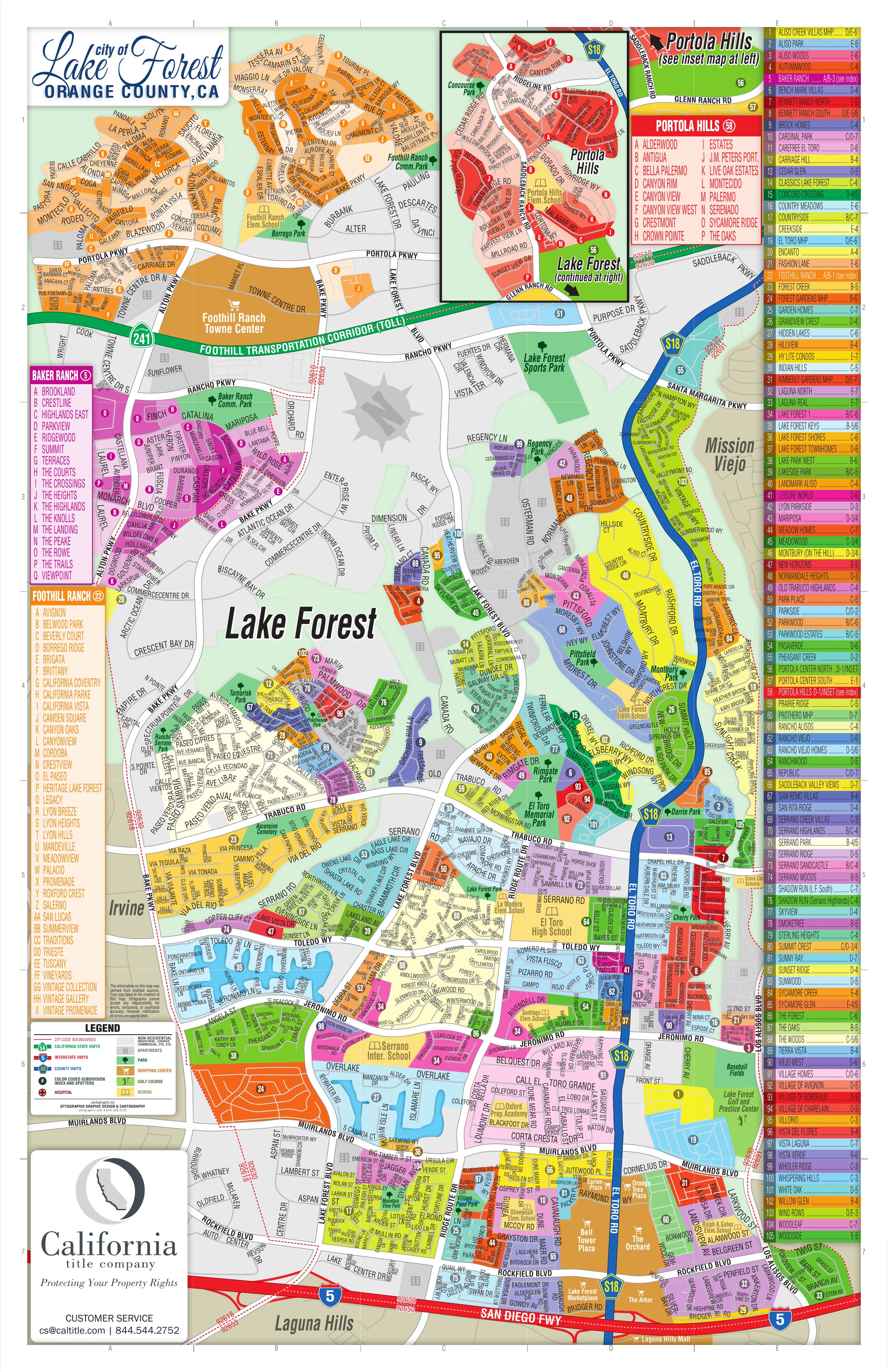
The Lake Forest Subdivision Map

The map makes visible what a citywide market report cannot: Lake Forest is made up of dozens of individual subdivisions, plus large internal neighborhood systems inside Foothill Ranch, Portola Hills and Baker Ranch.

Color-coded Lake Forest subdivision map showing established Lake Forest, Foothill Ranch, Portola Hills, Baker Ranch, major roads, schools, parks, and subdivision indexes

Pinch, scroll or use the controls to zoom. Drag to pan.

Subdivision research aid. The map itself notes that it was compiled from multiple sources and may contain errors, omissions or positional inaccuracies. Tract and boundary verification should use official City GIS and recorded tract maps.

The map indexes 105 numbered areas on the main sheet and carries separate internal indexes for Baker Ranch, Foothill Ranch and Portola Hills. It is a research aid for orientation. It is not a recorded tract map, a legal boundary source or a current subdivision register, and the map itself notes that it was compiled from multiple sources and may contain errors, omissions or positional inaccuracies. Verify tract and boundary questions through official City GIS and recorded tract maps.

Orientation and Geography

Roads and landform do most of the organizing work in Lake Forest. Crossing one arterial can mean entering a different subdivision, association structure, housing era, school assignment and competitive set.

I-5 and El Toro Road

The southwestern gateway and one of the strongest transportation and commercial influences in the city. Homes here should not be compared automatically against quieter central tracts or foothill product.

Lake Forest Drive, Jeronimo, Trabuco

These roads organize much of established Lake Forest. Crossing one can change the subdivision, the association, the housing era and the school assignment.

Bake Parkway and Alton Parkway

Critical to modern Lake Forest and to Irvine and Spectrum access. Baker Ranch, Serrano Summit and The Meadows participate in a more Irvine-oriented buyer ecosystem than many South County buyers expect.

Portola Parkway and SR-241

The primary foothill circulation system. Strong regional access is an advantage, while direct toll-road exposure raises a separate noise and outdoor-use question.

Glenn Ranch Road and Saddleback Ranch Road

The practical key to telling original Portola Hills apart from the modern Portola Center neighborhoods.

Serrano Creek and Aliso Creek

Natural corridors that create trail systems, greenbelt adjacency and physical separations between neighborhoods.

Whiting Ranch Wilderness Park

A major open-space edge for Foothill Ranch and Portola Hills. Proximity can create trail appeal, view and privacy value, and fire and insurance diligence at the same time.

Development Timeline

Lake Forest reads as a sequence of development generations, each of which is still visible in the housing stock.

  1. Rancho era

    Rancho Canada de los Alisos

    The Serrano family land grant is foundational to the land history of the city. Local historical sources differ on whether the original grant should be dated to 1842 or 1846; the broader rancho history is well established, but the exact date remains flagged for reconciliation.

  2. Late 1800s

    Dwight Whiting and the eucalyptus groves

    Whiting acquired substantial portions of the subdivided rancho land and planted large eucalyptus groves. Those groves became a defining part of the modern Lake Forest identity and are still the physical signature of the older neighborhoods.

  3. Early to mid 1900s

    El Toro and the postwar period

    The historic El Toro settlement, rail access, agriculture and later Marine Corps Air Station El Toro shaped how the larger area grew. Historical airport land-use and flight-noise mapping is still being gathered before any specific noise-contour claim is published.

  4. 1960s and 1970s

    Original Lake Forest master planning

    City historical materials attribute the modern community to 1960s planning built around the mature eucalyptus groves, man-made lakes, recreation and curvilinear suburban streets. Developer attribution continues to be verified from primary planning and recorded sources.

  5. December 20, 1991

    Incorporation

    Lake Forest incorporated as a city.

  6. 1987 to 2000

    Foothill Ranch

    The Foothill Ranch community organization reports that Hon Development purchased nearly 3,000 acres in 1987, that physical development began in 1989 and first home sales around 1990, that most original development was complete by the end of the 1990s, and that Foothill Ranch became part of Lake Forest in 2000.

  7. 1980s and 1990s

    Portola Hills

    Portola Hills developed largely as an unincorporated foothill community before later joining Lake Forest. The exact annexation year is being confirmed from City and LAFCO records before it is recorded as permanent fact.

  8. 2000s onward

    Opportunities Study Area and the modern infill era

    The City Opportunities Study Area process moved large underutilized parcels into new residential development. This is the clearest citywide divide: established Lake Forest is mature suburban product, while modern Lake Forest is contemporary Orange County master-planned and infill product.

  9. 2010s

    Baker Ranch, Portola Center and Serrano Summit

    Three separate modern master plans delivered in the same decade, with different builders, different tax structures and different product ladders. They should not be treated as one new-construction category.

  10. 2020s

    The Meadows

    The newest major master plan, developed on a former nursery site, completing the current generation of Lake Forest new construction.

The Original Lake Forest Market

Original Lake Forest is where the name, the mature streetscape and the private lake associations come from. It is also where the biggest valuation mistakes get made, because homes of similar size can be very different products.

Common advantages include mature landscaping and established streets, conventional suburban lots, meaningful single-story inventory, distinctive late 1960s and 1970s architecture, private recreational associations in certain tracts, and a residential character that newer master plans cannot reproduce.

Common tradeoffs include older physical systems, remodeling quality that varies significantly from home to home, compartmentalized original floor plans in some tracts, association structures that are not obvious from the street, and strong micro-location differences between waterfront, greenbelt, interior, road-edge and school-adjacent homes.

Agent rule: do not describe a property as simply a 1970s Lake Forest home. Identify the tract first. The subdivision map shows that central Lake Forest alone contains dozens of distinct subdivisions.

Lake 1 and Lake 2 Are Two Separate Systems

There are two private lake-recreation systems in Lake Forest, and they are not interchangeable. Proximity to water does not establish membership in either one. Association rights follow the deed, the association record and title, so they are verified property by property.

SystemClub and locationStructureWhat must be verified
Lake 1Lake Forest Community Association, Beach and Tennis Club, 22921 Ridge Route DriveOriginal deeded recreation association. Current association materials identify swimming, a swim lagoon, tennis, pickleball, basketball, volleyball, fitness and clubhouse facilities.Which properties actually carry membership. The research associates nearby original communities such as Hidden Lakes, Lake Forest Shores and Lake Forest Townhomes with this system, but eligibility must be confirmed from the deed, association records, title or current resale documents.
Lake 2Lake Forest II Master Association, Sun and Sail Club, 24752 Toledo WayEstablished 1970 and comprising 3,436 homes. Current materials identify multiple pools, fitness, six lighted tennis courts, twelve lighted pickleball courts, basketball, volleyball and community spaces. Five sub-associations are verified: Lake Forest Keys, Lakeside Park, The Oaks, Serrano Woods and Villas Del Lago.Whether a property carries only the master relationship or also a sub-association, and whether maintenance, gating or private-street responsibility differs from the home next door.

Current dues, transfer fees, rental rules and special assessments are not published here because they are dynamic. They are recorded only with an amount, a frequency, a source and an as-of date.

Waterfront Is Its Own Micro-Market

Near the lake is not one housing product. Direct water frontage with a private dock, a water view without equivalent direct-use rights, a greenbelt or lake-adjacent location, an ordinary interior association location, and a nearby home outside the association are five different value propositions that are frequently compared as though they were one.

Lake Forest Keys and Hidden Lakes are the two highest-priority targets for deeper waterfront research, because the dock and frontage question cannot be answered from general association comparables.

Research note: waterfront and dock premiums require tract- and condition-matched MLS analysis. Lake Forest City V1 intentionally does not assign a generic percentage.

Foothill Ranch

Foothill Ranch functions as a major submarket rather than as a single tract. It is primarily a late 1980s and 1990s master-planned foothill community with detached neighborhoods, attached product, commercial and employment components, SR-241 access, the Foothill Ranch Towne Centre, neighborhood parks and Whiting Ranch adjacency.

The reference map identifies 35 internal Foothill Ranch labels. Those are map-confirmed names, not proof that each one is a recorded tract, an HOA, a builder collection or a standalone neighborhood. Each is classified only after GIS, recorded-map and HOA research. The full index appears in the research directory below.

  • Elevation and view

    Upper versus lower elevation and view versus no view are among the strongest physical differentiators inside the community.

  • Interior versus perimeter

    Perimeter homes carry different exposure to arterials, the toll road and open space than interior homes on the same plan.

  • Open-space backing

    Direct backing to open space can add privacy and view while raising the fire and insurance question at the same time.

  • SR-241 exposure

    Strong regional access is a benefit; homes physically closest to the toll road still need an honest outdoor-noise assessment.

  • Attached versus detached

    The community contains both. They are separate segments with separate buyers, not a single price per square foot.

  • HOA and sub-HOA

    Association and sub-association structure varies between neighborhoods and affects total monthly cost.

  • Fire classification

    Never describe every Foothill Ranch property with one fire classification. Work from the actual address to the current official hazard map to an insurer quote.

  • Aging 1990s systems

    Roof, plumbing, HVAC and window condition matter on product now passing thirty years.

Original Portola Hills

Original Portola Hills is a separate real-estate product from modern Portola Center, and keeping them apart is one of the more useful distinctions an agent can make in this city.

Compared with central Lake Forest, it generally introduces more elevation, stronger canyon and ridgeline relationships, foothill and wilderness context, more 1980s and 1990s architecture, greater slope variation, and more property-specific fire and insurance diligence. Compared with Portola Center, it represents an older generation of housing with different lot patterns, different HOA structures and a different tax and assessment context.

The reference map identifies 16 internal Portola Hills labels, listed in the research directory below. They still need tract-level classification.

If a buyer says they like Portola Hills, the next question is whether they mean established Portola Hills or whether they are also including the newer Portola Center and IronRidge neighborhoods.

Portola Center and IronRidge

Portola Center is the modern foothill master plan, and City materials describe the project scale directly.

Nearly 196 acres
The overall project area described in current City materials.
926 homes
The home count at project completion identified by the City.
Five-acre public park
Plus private neighborhood parks within the community.
More than 44 acres of open space
With trails and pedestrian connections through the project.
About 10,000 square feet of commercial
A small commercial component integrated into the plan.
Project-specific Mello-Roos
The City maintains public information for the Portola Center CFD. This is an active diligence item for any purchase here.

The research associates IronRidge and Portola Center South with Landsea Homes and labels such as Brookhaven, Windstone, Sagebluff, Copperleaf and Silver Oak, and portions of Portola Center North with Baldwin and Sons. Final builder and neighborhood mapping is still being verified from City, builder, HOA and recorded documents. Note also that Lake Forest contains more than one place called The Oaks, so records here are always qualified by parent geography.

Baker Ranch

Baker Ranch is one of the most strategically important modern communities in Lake Forest, and one of the most frequently cross-shopped against Irvine.

It competes on contemporary floor plans, extensive recreation, Irvine and Spectrum proximity within South County geography, multiple housing tiers, and its tax structure. The common tradeoffs are more compact lots than many established Lake Forest tracts, a stronger community and HOA structure, closer spacing in some collections, less mature landscaping, and location-specific toll-road or arterial exposure.

Historic entitlement materials approved as many as 2,379 residential units. Because secondary sources vary on the final built-home count, that figure is treated here as planning history rather than as a built total. The reference map identifies seventeen internal Baker Ranch labels, which are listed in the research directory. Shea Homes and Toll Brothers are the major builders identified in the research, pending tract-by-tract verification.

Depending on price and floor plan, the real competitive set usually includes other Baker Ranch collections, Serrano Summit, The Meadows, IronRidge and Portola Center, newer Irvine product, Rancho Mission Viejo, and larger renovated homes in established Lake Forest. Product, total monthly cost and lifestyle drive that set far more than the city name does.

Verified tax distinction: Baker Ranch does not carry the Baker Ranch Mello-Roos CFD tax, because the infrastructure obligation was paid in cash rather than financed through the CFD. This does not translate into a single effective property-tax percentage, and the actual tax bill still needs parcel-level verification.

Serrano Summit

Serrano Summit is a separate modern market from Baker Ranch and The Meadows. City planning materials describe approximately 98.9 acres with multiple housing forms integrated with the Civic Center and Sports Park area. Its differentiators are newer construction, elevated geography, civic and recreation adjacency, compact modern product and contemporary amenities.

The planning history is deliberately preserved rather than reconciled into a single number.

FigureValueSource context
Earlier entitlement capacityUp to 608 unitsEarlier entitlement materials. Retained as planning history.
Later project program537 homesCity of Lake Forest 2021 Housing Element.
Project areaApproximately 98.9 acresCity planning materials describing multiple housing forms integrated with the Civic Center and Sports Park area.

The Gemini research identifies Lennar collections including Arieta, Siena, Soria, Castellon and Amara, and City housing materials also reference Covera. The final complete neighborhood hierarchy is still being established from City approved maps, recorded tracts, archived builder sales literature and HOA documents.

The Meadows

The Meadows represents the newest major master-plan generation in Lake Forest, developed on a former nursery site with Toll Brothers as the major builder. It should be evaluated as late-generation new construction with contemporary multigenerational and flexible plans, resort-style amenities and active CFD and special-assessment diligence.

About 126 acres
The project area identified in City housing materials.
541 single-family homes
The final housing program identified in the City Housing Element.
65 senior affordable units
Included in the approved program alongside the market-rate homes.
More than 20 acres
Parks, open space and habitat-related land within the community.

The original Area Plan allowed a larger maximum market-rate program. Original entitlement capacity is not the same as the final housing program, and both are kept. The final builder collection hierarchy is still being determined from official Toll Brothers archives and HOA and tract records. A Meadows listing should not be priced against all Lake Forest four-bedroom homes; the likely competitive set is the same or adjacent Meadows collection, Baker Ranch premium product, Serrano Summit premium detached and selected newer Irvine resale.

More Modern Lake Forest

The modern growth story extends beyond the four headline master plans. These smaller projects are grouped on their own rather than folded into the larger communities, because their buyers and cost structures are distinct.

Parkside

Toll Brothers

A former industrial and sand-and-gravel site redeveloped with housing. City materials identify approximately 195 single-family dwellings.

Encanto

Infill

City housing materials identify approximately 52 single-family units.

Teresina

Formerly Pinnacle at Serrano Highlands

Previously identified in planning contexts under the earlier name, which is worth knowing when older documents surface.

Other infill labels

Map-confirmed

The subdivision map also carries labels such as Lyon Parkside, Mariposa and Whisler Ridge that belong to the modern and infill era rather than to a headline master plan.

The El Toro and I-5 Corridor

The western and southern portion of the city is a dense patchwork of condominiums, townhomes, mobile-home communities, older detached neighborhoods and commercial edges near Muirlands Boulevard, Rockfield Boulevard, El Toro Road, I-5 and the rail corridor. It contains many of the more attainable ownership opportunities in Lake Forest, and older detached alternatives without the amenity structure of a modern master plan.

City planning strategy also identifies future mixed-use and redevelopment opportunities in several corridors here, so diligence should account for current surroundings, approved and planned land use, and the future development context together.

  • Freeway exposure

    Distance and orientation to I-5 vary substantially within short distances.

  • Rail proximity

    The rail corridor is a separate consideration from the freeway and affects different streets.

  • Commercial adjacency

    Backing or siding to commercial use changes both livability and the comparable set.

  • Collector-road traffic

    Arterial and collector frontage should be adjusted for rather than ignored.

  • HOA versus non-HOA

    Both exist here, and the difference changes total monthly cost materially at this price point.

  • Parking

    Assigned, garage, carport and street parking vary widely across the attached communities.

  • Lot usability

    Older detached pockets can offer usable yards that newer compact-lot product cannot.

  • Surrounding redevelopment

    Check approved and planned land use nearby, not just what is standing today.

The original research proposed exact percentage discounts for freeway, rail and arterial exposure. Those are research hypotheses requiring paired-sales analysis and are not published here as market facts.

Housing Product by Era

Housing era is the single most efficient way to predict which diligence questions matter. It is not a way to predict a defect. Two homes from the same year can be in completely different condition.

EraTypical Lake Forest expressionPrincipal diligence questions
1960s to early 1970sRanch and California-modern product, original Lake ForestRemodel quality, plumbing, electrical, roof, sewer lateral, permitted additions
1970s to early 1980sLake communities, Woods-style architecture, larger detached move-up productFloor-plan functionality, repipe history, roof, original systems, exact association membership
1980sEstablished infill, Montbury, early Portola HillsLarger lots, views, slope and retaining conditions, 1980s architecture and mechanical systems
1990sFoothill Ranch and Portola Hills buildoutInterior versus perimeter, elevation, toll-road and open-space exposure, systems now passing thirty years
2000sSmaller infill and transition-period productAssociation structure, density, builder-specific product differences
2010sBaker Ranch, Portola Center and IronRidge, Serrano SummitModern floor plans, small-lot design, HOA, CFD and tax differences, solar ownership
2020sThe Meadows and completion of recent master plansNewer resale comparables, HOA and CFD, builder options, view and privacy, early-lifecycle maintenance

Detailed claims about plumbing materials, sewer materials, soils and roof systems from the underlying research are treated here as inspection-question scaffolds, not as tract-wide property-condition facts.

Schools and Boundary Verification

Lake Forest is served by Saddleback Valley Unified School District. Schools located in or closely associated with the city include El Toro High School, Serrano Intermediate, Los Alisos Intermediate, Foothill Ranch Elementary, Portola Hills Elementary, Lake Forest Elementary, Rancho Canada Elementary, Olivewood Elementary, Santiago STEAM Magnet and Gates Dual Language Immersion, among other district campuses.

School boundaries can cross neighborhood lines and can change. This platform does not publish neighborhood-to-school guarantees. Use the district address-level locator for a specific property.

General feeder patterns described in secondary research may be directionally useful, but they are not stored or published here as address-level guarantees.

HOA Structure Can Change Block by Block

Lake Forest has an unusually varied association landscape for a single city. Two homes a few streets apart can have entirely different amenity access, monthly cost and maintenance responsibility.

Original recreation associations

Lake Forest Community Association with the Beach and Tennis Club, and Lake Forest II with the Sun and Sail Club. Separate systems with separate memberships.

Master plus sub-association

Verified within Lake Forest II, whose sub-associations are Lake Forest Keys, Lakeside Park, The Oaks, Serrano Woods and Villas Del Lago. A property can carry both relationships.

Modern master-planned associations

Baker Ranch, Serrano Summit, The Meadows, IronRidge and Portola Center, and other newer communities, each with their own amenity and cost structure.

Attached-community associations

Numerous condominium and townhome associations appear across the subdivision map, particularly in the western and southern corridor.

Low or no-HOA pockets

Several candidate areas are identified in the research, including Normandale Heights. Exact status is verified through City HOA GIS, title and recorded documents rather than assumed.

Current HOA dues, transfer fees, rental rules, gate and private-street responsibilities and special assessments should be verified through current association and escrow documents. Dues are recorded on this platform only with an amount, a frequency, a source and an as-of date.

Taxes Are Community-Specific

Lake Forest should never be described with one generic citywide effective tax rate. Baker Ranch carries a verified distinction, Portola Center carries an active project-specific CFD framework, other newer communities require property-level verification, and older construction does not automatically mean no special assessment.

General community context is shown on this page. Exact property taxes, fixed special assessments, Mello-Roos and bond obligations require parcel-level verification against the actual secured tax bill and the applicable CFD documentation.

This platform does not publish generic effective tax bands for Lake Forest neighborhoods. A rate is only recorded when it is tied to a dated, parcel-level or formally documented source.

Foothill Living Requires Property-Level Fire and Insurance Diligence

Current official mapping shows Lake Forest containing Moderate, High and Very High Fire Hazard Severity Zones. City safety materials indicate that significant portions of Foothill Ranch and Portola Hills sit within higher-hazard foothill geography. That is not the same as saying every foothill property carries the same classification, and this page does not make that claim.

The working sequence is the actual address, then the current official hazard map, then an insurer quote, then the HOA and fuel-modification context, then defensible-space and disclosure review. For foothill and open-space homes, insurance should be investigated early enough that premium, policy type, lender qualification and coverage availability do not become late-escrow surprises.

This page does not state that a specific carrier will or will not write a tract, that a home requires FAIR Plan coverage, or what a typical premium is. Insurance is dynamic and property-specific and is treated as market intelligence rather than as a durable tract fact.

What to Ask by Construction Era

Local construction knowledge should improve due diligence, not create blanket assumptions about an entire neighborhood. These are question sets, not condition claims.

Established central Lake Forest

1960s to early 1980s

Original versus replaced plumbing, evidence of prior leaks, sewer-lateral condition, roof age and material, electrical updating, windows, HVAC, permits for remodeling and additions, slab and foundation observations, and mature-tree and root interaction.

1980s and 1990s foothill product

Foothill Ranch and Portola Hills

Plumbing, roof underlayment, HVAC and windows on systems now passing thirty years, retaining and slope conditions where relevant, drainage, the open-space interface, and fire and insurance.

Modern construction

2010s and 2020s

Solar ownership versus lease or PPA, builder structural options, lot-line proximity, HOA architectural rules, CFD obligations, drainage, post-construction modifications, EV charging, smart-home systems and warranty history.

Lifestyle and Practical Geography

These are the places that actually change a residential decision in Lake Forest, and the reason each one matters.

Whiting Ranch Wilderness Park

A major open-space asset for Foothill Ranch and Portola Hills. Trail access, mountain biking, hiking, open-space views and privacy on one side; wildfire and open-space diligence on the other.

Lake Forest Sports Park

The major municipal recreation anchor on the newer Civic Center and Serrano Summit side of the city, and part of why that area reads differently from the older core.

Heritage Hill Historical Park

Preserves structures associated with the Serrano family, El Toro, early schools, church history and the Bennett Ranch period. It is the physical record of the citys pre-suburban history.

The lake recreation associations

Private, deeded amenity rather than public park. Always distinguish a municipal park, a public trail, a private HOA clubhouse, a deeded lake association and a sub-association amenity.

Foothill Ranch Towne Centre

Foothill Ranch integrates residential, commercial, employment and recreation more directly than most established central tracts, which is part of its appeal for some buyers.

Trails and creek corridors

Serrano Creek and Aliso Creek create trail systems and greenbelt adjacency that materially affect specific streets rather than whole neighborhoods.

Irvine and Spectrum access

Especially relevant for Baker Ranch, western Foothill Ranch, Serrano Summit and The Meadows, and a major reason those communities compete against Irvine product.

SR-241 and I-5 access

Two different regional access stories. The toll road serves the foothill communities; I-5 serves the western and southern corridor with a different exposure tradeoff.

What Buyers Actually Compare

These are the real decisions Lake Forest buyers make. None of them has a universal winner. Each is a tradeoff, and the right answer depends on what the buyer is willing to give up.

Established Central Lake Forest vs. Baker Ranch

Age and lot versus floor plan and amenity

Established offers larger conventional lots more often, mature canopy, more single-story opportunities and possible lake-association access, against older physical systems. Baker Ranch offers newer construction, modern layouts, resort-oriented planning and no Baker Ranch Mello-Roos, against generally more compact lots and less mature landscaping.

Foothill Ranch vs. Central Lake Forest

1990s foothill versus 1970s core

Foothill Ranch brings 1990s product, SR-241 access, foothill geography, open-space relationships and a stronger internal subdivision hierarchy. Central Lake Forest brings older product, mature trees, lake-club possibilities, more traditional lot patterns and central school and park access.

Original Portola Hills vs. Portola Center

Two generations, one name

Original Portola Hills is older and more established with different lots, architecture and tax and HOA structure. Portola Center is newer with modern floor plans, contemporary amenities, active CFD diligence and different density. Treating them as one market is a common and costly error.

Baker Ranch vs. The Meadows

Modern versus newest

Compare builder, construction generation, lot, square footage, architecture, tax and CFD, HOA, amenities, privacy, buyer price band, surrounding land uses and resale competition. The tax structures differ, so compare total monthly cost rather than sale price alone.

Modern Lake Forest vs. Irvine

The payment question

Avoid the claim that one city is a fixed percentage cheaper. The useful question is what combination of square footage, lot, tax burden, school district, amenities, commute and housing age the buyer can obtain in each market at the same budget and monthly payment.

Buyer Intelligence

Lake Forest is unusually useful for buyers who want genuine choice across housing generations. The tradeoff is complexity: housing age, HOA structure, tax and CFD, topography, fire classification, lot pattern and nearby competition can all change dramatically within a short drive.

  • Mature traditional neighborhoods

    Established streets, tree canopy and conventional lots concentrated in the original and central city.

  • Single-story inventory

    Meaningfully more available in the older central tracts than in modern construction.

  • Private lake and recreation associations

    Two separate systems, verified property by property rather than by proximity.

  • Foothill living

    Elevation, views and open space in Foothill Ranch and Portola Hills, with fire and insurance diligence attached.

  • Resort-style modern master planning

    Baker Ranch, Serrano Summit, The Meadows and Portola Center each offer a different amenity and product ladder.

  • Irvine and Spectrum access

    Northern and modern Lake Forest participates in an Irvine-oriented commuter ecosystem.

  • Modern product without Baker Ranch Mello-Roos

    A real and verified structural advantage in the Baker Ranch monthly-cost comparison.

  • Larger established lots

    Concentrated in select established communities such as Montbury, subject to lot-range verification.

  • Entry attached ownership

    Condominium and townhome product, much of it in the western and southern corridor.

  • Waterfront

    A genuinely scarce product that needs its own comparable set rather than association averages.

  • Newer move-up and luxury housing

    The Meadows and premium Baker Ranch tiers anchor the newest end of the market.

The right Lake Forest neighborhood is usually determined less by the city name and more by the buyer preferred tradeoff among age, lot, amenities, taxes, topography and floor plan.

Seller Intelligence

The biggest Lake Forest pricing mistake is using the entire city as the competitive set. A 2,500 square foot Lake Forest home may compete primarily with the same floor plan in the same tract, adjacent plans in the same association, a nearby tract from the same era, or a different city entirely if buyers at that price are cross-shopping there.

The working sequence is tract, then floor plan, then lot, then street, then condition, then HOA and tax structure, then neighboring alternatives.

Established homes

Condition can move a home into a different competitive tier. A modernized older home may compete above the tract average, but it does not automatically become equivalent to newer construction.

Waterfront sellers

Use waterfront comparables before general association comparables. A dock property should not be valued off a non-waterfront home merely because they share an association.

Newer-community sellers

Compare total monthly ownership cost including price, HOA, tax, CFD and insurance where material. A Baker Ranch home with no Baker Ranch Mello-Roos should not be compared on sale price alone against a community carrying a materially different assessment.

Foothill sellers

Market view, privacy, open space and trail access while handling fire, insurance, slope and road access accurately and early rather than at inspection.

Perimeter and road-edge sellers

Do not rely on superior interior comparables without adjustment. Exposure is a real and measurable difference.

Single-story sellers

Rare single-story product should not be compared mechanically against two-story homes just because living area is similar.

Original Portola versus IronRidge

These are different generations of housing. A same-city, same-size comparison across that line will misprice the home in one direction or the other.

Renovated 1970s with a large lot

Can compete effectively against new construction because it offers usable yard and mature setting that compact-lot communities cannot duplicate.

Micro-Market Value Framework

This is what the research will ultimately measure at the property level. The factors are established; the magnitudes are not, and this platform does not publish percentage adjustments before the paired-sales work is done.

FactorWhere it matters mostV1 status
Direct lake frontage and dockLake Forest Keys, Hidden Lakes, lakefront productEstablished differentiator; premium magnitude requires MLS research
Lake or club associationCentral Lake ForestEstablished structure; exact property eligibility is property-specific diligence
Mature canopyThe Woods and the established coreEstablished differentiator; premium requires MLS research
Single storyOlder central tractsEstablished differentiator
Large lotMontbury and select established areasProperty-specific diligence; tract lot ranges still being verified
View and elevationPortola Hills, Foothill Ranch, modern ridge areasEstablished differentiator; premium requires MLS research
Open-space backingFoothill and Portola locationsEstablished differentiator with an offsetting fire and insurance question
SR-241 exposureFoothill and northeastern modern areasMLS research needed; measure via paired sales
I-5, rail and arterial exposureWestern and southern cityMLS research needed; measure via paired sales
Interior cul-de-sacCitywideEstablished differentiator when otherwise comparable
CFD or special assessmentNewer communitiesProperty-specific diligence; affects total payment and competitive set
Modern floor planBaker Ranch, The Meadows, Serrano Summit, Portola CenterEstablished cross-era differentiator
HOA amenityLake communities and modern master plansBuyer-specific rather than universally positive
School boundaryAddress specificProperty-specific diligence; verify through the district locator
Remodel qualityEstablished cityEstablished differentiator and a major valuation variable
Gate or private streetSelected newer and attached areasProperty-specific diligence

Community and Subdivision Research Directory

The reference map indexes 105 names on the main sheet plus separate internal indexes for Baker Ranch, Foothill Ranch and Portola Hills. Those names are the research queue and the geographic inventory, not 105 future public pages. Some are recorded tracts, some are marketing names, some are HOA names, some are builder collections, some are attached complexes and some are broader neighborhood labels. Each is reconciled before it is promoted to its own profile.

Names are grouped here under the market environment the City V1 source supports. Where the source does not yet place a name, it is held in the citywide index rather than guessed into a community.

Original / Central Lake Forest

Research In Progress
  • Hidden Lakes
  • Lake Forest 1
  • Lake Forest Keys
  • Lake Forest Townhomes
  • Lakeside Park
  • Park Place
  • Parkwood Estates
  • Ranchwood
  • Serrano Woods
  • The Oaks (Lake Forest II)
  • The Woods
  • Villas Del Lago

Independent Established Communities

Research In Progress
  • Bennett Ranch North
  • Bennett Ranch South
  • Montbury on the Hill
  • Normandale Heights
  • Serrano Highlands
  • Serrano Park

Foothill Ranch

Research In Progress
Show all 35 subdivisions
  • Avignon
  • Belwood Park
  • Beverly Court
  • Borrego Ridge
  • Brigata
  • Brittany
  • California Coventry
  • California Parke
  • California Vista
  • Camden Square
  • Canyon Oaks
  • Canyonview
  • Cordoba
  • Crestview
  • El Paseo
  • Heritage Lake Forest
  • Legacy
  • Lyon Breeze
  • Lyon Heights
  • Lyon Hills
  • Mandeville
  • Meadowview
  • Palacio
  • Promenade
  • Roxford Crest
  • Salerno
  • San Lucas
  • Summerview
  • Traditions
  • Trieste
  • Tuscany
  • Vineyards
  • Vintage Collection
  • Vintage Gallery
  • Vintage Promenade

Portola Hills (Original)

Research In Progress
  • Alderwood
  • Antigua
  • Bella Palermo
  • Canyon Rim
  • Canyon View
  • Canyon View West
  • Crestmont
  • Crown Pointe
  • Estates
  • J.M. Peters Portola
  • Live Oak Estates
  • Montecido
  • Palermo
  • Serenado
  • Sycamore Ridge
  • The Oaks (Portola Hills)

Portola Center / IronRidge

Research In Progress
  • Brookhaven
  • Copperleaf
  • Portola Center North
  • Portola Center South
  • Sagebluff
  • Silver Oak
  • Windstone

Baker Ranch

Research In Progress
  • Brookland
  • Crestline
  • Highlands East
  • Parkview
  • Ridgewood
  • Summit
  • Terraces
  • The Courts
  • The Crossings
  • The Heights
  • The Highlands
  • The Knolls
  • The Landing
  • The Peake
  • The Rowe
  • The Trails
  • Viewpoint

Serrano Summit

Research In Progress
  • Amara
  • Arieta
  • Castellon
  • Covera
  • Siena
  • Soria

The Meadows

Research In Progress

Modern Infill

Research In Progress
  • Encanto
  • Lyon Parkside
  • Mariposa
  • Parkside
  • Teresina
  • Whisler Ridge

El Toro / I-5 Corridor

Research In Progress

Citywide Map Index - Needs Hierarchy Verification

Research In Progress
Show all 77 subdivisions
  • Aliso Creek Villas MHP
  • Aliso Park
  • Aliso Woods
  • Autumnwood
  • Bench Mark Villas
  • Brock Homes
  • Cardinal Park
  • Carefree El Toro
  • Carriage Hill
  • Cedar Glen
  • Classics Lake Forest
  • Concord Crossing
  • Country Meadows
  • Countryside
  • Creekside
  • El Toro MHP
  • Fashion Lane
  • Forest Creek
  • Forest Gardens MHP
  • Garden Homes
  • Grandview Crest
  • Hillview
  • Hy Lite Condos
  • Indian Hills
  • Kimberly Gardens MHP
  • Laguna North
  • Laguna Real
  • Lake Park West
  • Landmark Aliso
  • Leisure World
  • Meadow Homes
  • Meadowood
  • New Horizons
  • Old Trabuco Highlands
  • Parkwood
  • Pasaverde
  • Pheasant Creek
  • Prairie Ridge
  • Prothero MHP
  • Rancho Alisos
  • Rancho Viejo
  • Rancho Viejo Homes
  • Republic
  • Saddleback Valley Views
  • Sam Remo Villas
  • San Rita Ridge
  • Serrano Creek Villas
  • Serrano Ridge
  • Serrano Sandcastle
  • Shadow Run (L.F. South)
  • Shadow Run (Serrano Highlands)
  • Skyview
  • Smoketree
  • Sterling Heights
  • Summit Crest
  • Sunny Ray
  • Sunset Ridge
  • Sunwood
  • Sycamore Creek
  • Sycamore Glen
  • The Forest
  • Tierra Vista
  • Viejo West
  • Village Homes
  • Village of Avignon
  • Village of Bordeaux
  • Village of Charelain
  • Villorio
  • Vista Del Flores
  • Vista Laguna
  • Vista Verde
  • Whispering Hills
  • White Oak
  • Willow Glen
  • Wind Rows
  • Woodleaf
  • Woodside

Where the Lake Forest Research Goes Next

This platform gets deeper on a schedule rather than all at once. These twenty areas are the current priority queue, ordered by how much a deeper profile would change an actual pricing or buying decision.

PriorityAreaWhy it deserves deeper research
1Lake Forest KeysUnique waterfront and dock valuation problem
2The WoodsDistinct architecture, mature setting, multiple builder questions
3Parkwood EstatesEstablished move-up benchmark
4RanchwoodSingle-story scarcity and valuation question
5Hidden Lakes and Lake 1 waterfrontSeparate waterfront-association market
6Montbury on the HillLarge-lot, equestrian and estate alternative
7Serrano ParkEstablished central move-up competitor
8Baker Ranch premium detached tierModern luxury benchmark
9Baker Ranch entry tiersAttached versus detached affordability benchmark
10IronRidge and BrookhavenModern foothill with CFD and fire-interface issues
11J.M. Peters PortolaPremium established foothill product
12AlderwoodCore Portola Hills family resale
13Representative Foothill Ranch detached tractEstablishes the 1990s foothill benchmark
14Representative Foothill Ranch attached tractEntry segment benchmark
15Serrano SummitFinal neighborhood hierarchy still incomplete
16The MeadowsFinal builder-collection hierarchy still incomplete
17Normandale HeightsLow or no-HOA value proposition
18Bennett Ranch North and SouthMap suggests meaningful internal segmentation
19ParksideModern infill outside the headline master plans
20El Toro and I-5 attached clusterEntry-level and redevelopment-market intelligence

Lake Forest Market Data

Current MLS-derived market evidence for Lake Forest. These figures describe transactions, not the durable structure of the market above them: a median price moves with whatever happened to sell in a window, while the community, tract and micro-location distinctions covered on this page continue to explain why two similar homes trade differently. Figures are recalculated on a schedule from CRMLS data supplied through SimplyRETS, and property-specific facts should always be verified against the listing.

Snapshot calculated September 2, 2026 at 9:55 PM Pacific (about 10 hours ago). These figures are generated on a schedule, not queried live when the page loads. The MLS feed itself last updated September 2, 2026 at 6:36 PM Pacific.

Market now

Point-in-time inventory at the calculation time above

Active listings

208

Status: Active only

Coming soon

6

Status: ComingSoon

Active under contract

24

Accepting backup offers

Pending

23

Under contract

Median active list price

$1.29M

Sample: 208 active listings

Median active days on market

40 days

MLS days on market, active inventory

Last 30 days

August 4 – September 3, 2026 · closed sales counted by close date

New listings

69

First listed in this window, whatever their status today. 26% fewer than the prior 30 days (93)

Closed sales

52

10% fewer than the prior 30 days (58)

Median closed price

$1.22M

4% lower than the prior 30 days ($1.27M)

Median closed days on market

19 days

48% longer than the prior 30 days (13 days)

Closed price per sq ft

$630/sq ft

Median of closed price divided by living area

Median Sale-to-Last-List

99%

Median closed price against the final list price. Against the original list price: 99%.

Price & sales trend

Complete calendar months only, September 2025 to August 2026. 1,423 closed sales processed.

Lake Forest closed sales, monthly count
Lake Forest 3-month rolling median closed price(median of all closed sales in the trailing three months, not an average of monthly medians)

The 3-month rolling median closed price through August 2026 is 8% above the same rolling period a year earlier ($1.15M through August 2025), pooling 189 and 189 closed sales respectively.

Current competition by price band

Active listings only. 208 listings distributed across configured bands. Bar length is relative to the largest band.

  • Under $600K46 · 22%
  • $600K–$800K21 · 10%
  • $800K–$1.1M21 · 10%
  • $1.1M–$1.4M39 · 19%
  • $1.4M–$1.8M31 · 15%
  • $1.8M–$2.5M35 · 17%
  • $2.5M+15 · 7%
How these numbers are calculated

Source: CRMLS data via SimplyRETS. Market metrics are calculated from listings returned by the configured geographic query. Figures may change as MLS records are updated. Property-specific facts should be independently verified.

Geographic and property query: city in [Lake Forest] AND types included [Residential, Condominium, Townhome]; excluded [Rental, Commercial, CommercialLease, Land, Farm, Multi-Family]. Methodology version v2.

  • Only residential for-sale property is counted. Rentals, commercial, land, farm and multi-family income records returned by the same geographic query are excluded before any figure is calculated.
  • Most recent retrieval: 284 records returned, 23 excluded as outside the residential for-sale universe, 0 excluded as outside the mapped area, 261 counted.
  • Active Listings — MLS status Active. Homes actively on the market. Excludes homes under contract, pending, or coming soon.
  • Coming Soon — MLS status ComingSoon. Listings publicly announced but not yet showing as active in the MLS.
  • Active Under Contract — MLS status ActiveUnderContract. Under contract while still accepting backup offers.
  • Pending — MLS status Pending. Under contract, no longer accepting offers through the MLS.
  • Closed Sales — MLS status Closed. Recorded closed transactions, grouped by close date.
  • New listings count homes first listed inside the window, whatever status they hold now, so a home that listed and went pending in the same window is still counted as new.
  • Monthly history uses complete calendar months only. The month in progress is never charted, because a partial month reads as a collapse in sales.
  • Medians and ratios are suppressed below 5 qualifying observations rather than published from a small sample.
  • Sale-to-last-list divides close price by the final list price. Sale-to-original-list uses the original list price where the feed populates it. Both are shown to the nearest whole percent, which is the honest resolution for a median over this many sales.
  • Price per square foot divides close price by MLS living area; listings without living area are excluded.
  • Price charts use a 3-month rolling median of the pooled closed transactions, and the year-over-year figure quotes that same rolling median. Closed counts are monthly and unsmoothed.
  • Property tax figures are never derived from the MLS feed; the field is unpopulated in this feed. School, HOA and assessment facts come from the durable research on this page, not from listing data.
  • Snapshots are generated on a schedule rather than on page load, so figures reflect the calculation time shown above rather than a live query.
  • Listing change tracking began September 3, 2026. Price-reduction metrics appear only once a full tracking window exists.

How This Page Was Verified

Durable local knowledge is separated from dynamic and property-specific information throughout this platform. Structural facts about geography, development history, association structure and project scale are drawn from City of Lake Forest planning and housing materials, association materials, the district, county tax resources and the reference subdivision map.

School assignments, HOA dues, taxes, special assessments, fire classification, insurance availability and property condition are dynamic or property-specific. They are verified for the actual property rather than inherited from a neighborhood name, and they are not published here as durable facts.

Several items are deliberately left open rather than resolved into a confident claim: the Serrano land-grant date, the Portola Hills annexation year, the final built-home count at Baker Ranch, the final collection hierarchies at Serrano Summit and The Meadows, and the classification of most map labels as recorded tracts versus marketing names. Percentage premiums and discounts for waterfront, view, toll-road and freeway exposure are research hypotheses awaiting paired-sales analysis and are not published as facts.

Last researched and reviewed September 2026. Lake Forest City V1 is the first published depth layer for this city. Community and tract profiles will be added beneath it as verification completes.

Names that overlap the map, but are not subdivisions

Local Market Terminology

Buyers, sellers and agents use area names that do not match recorded subdivision boundaries. Rather than force them into the map hierarchy, this platform records them separately and notes what they overlap.

  • Lake 1 - Lake Forest Community Association

    Lake 1 · Beach & Tennis Club · LFCA

  • Lake 2 - Lake Forest II Master Association

    Lake 2 · Sun & Sail Club · Lake Forest II · LF2

Individual claims and classification

Market Knowledge Record

history

  • Lake Forest incorporated as a city on December 20, 1991.

    Verified Fact

  • Dwight Whiting acquired substantial portions of the subdivided rancho land in the late 1800s and planted the eucalyptus groves that define the older neighborhoods.

    Verified Fact

  • The Serrano family land grant, Rancho Canada de los Alisos, is the foundational land history of the area.

    Needs Verification

  • Portola Hills developed largely as an unincorporated foothill community before joining Lake Forest.

    Needs Verification

  • City historical materials attribute modern Lake Forest to 1960s master planning built around the eucalyptus groves, man-made lakes and recreation.

    Market Observation

geography

  • The City of Lake Forest is approximately 16.6 square miles.

    Verified Fact

  • The reference subdivision map indexes 105 numbered areas on the main sheet plus separate internal indexes for Baker Ranch, Foothill Ranch and Portola Hills.

    Verified Fact

  • Foothill Ranch carries 35 internal map labels and Portola Hills carries 16.

    Verified Fact

association

  • The Lake Forest II Master Association was established in 1970 and comprises 3,436 homes.

    Verified Fact

  • Lake Forest II has five verified sub-associations: Lake Forest Keys, Lakeside Park, The Oaks, Serrano Woods and Villas Del Lago.

    Verified Fact

  • Lake Forest contains two separate private lake-recreation systems: Lake Forest Community Association with the Beach and Tennis Club at 22921 Ridge Route Drive, and Lake Forest II with the Sun and Sail Club at 24752 Toledo Way.

    Verified Fact

  • Several candidate low or no-HOA pockets exist, including Normandale Heights.

    Reasonable Inference

taxes

  • Baker Ranch homeowners do not pay the Baker Ranch Mello-Roos tax, because the infrastructure obligation was paid in cash rather than financed through the community facilities district.

    Verified Fact

development

  • Portola Center comprises nearly 196 acres with 926 homes at completion, a five-acre public park, private neighborhood parks, more than 44 acres of open space and about 10,000 square feet of commercial space.

    Verified Fact

  • A project-specific community facilities district applies at Portola Center.

    Verified Fact

  • Serrano Summit occupies approximately 98.9 acres. Earlier entitlement materials contemplated up to 608 units; the City 2021 Housing Element identifies 537 homes.

    Verified Fact

  • The Meadows comprises approximately 126 acres with 541 single-family homes, 65 senior affordable units and more than 20 acres of parks, open space and habitat-related land.

    Verified Fact

  • Foothill Ranch: Hon Development purchased nearly 3,000 acres in 1987, development began in 1989 with first home sales around 1990, most original development was complete by the end of the 1990s, and the community became part of Lake Forest in 2000.

    Verified Fact

  • Parkside comprises approximately 195 single-family dwellings on a former industrial and sand-and-gravel site, with Toll Brothers as builder.

    Verified Fact

  • Encanto comprises approximately 52 single-family units.

    Verified Fact

  • Historic entitlement materials for Baker Ranch approved as many as 2,379 residential units.

    Verified Fact

schools

  • Lake Forest is served by Saddleback Valley Unified School District, and school assignment is address specific.

    Verified Fact

hazards

  • Current official mapping shows Lake Forest containing Moderate, High and Very High Fire Hazard Severity Zones, with significant portions of Foothill Ranch and Portola Hills in higher-hazard foothill geography.

    Verified Fact

market

  • Modern Lake Forest communities near Bake and Alton Parkway compete against Irvine and Spectrum-oriented product more than many South County buyers expect.

    Market Observation

  • Waterfront, view, toll-road and freeway exposure all measurably affect Lake Forest values.

    Reasonable Inference

  • Established central Lake Forest holds meaningfully more single-story inventory than the modern master plans.

    Market Observation

Sources & Verification

Durable review
September 1, 2026
Dynamic data
September 3, 2026
Research status
Available